At Perkins&Will, we proudly offer all of our U.S. employees paid parental leave because we believe that supporting parents has a positive impact in the workplace.
Having a child once meant for many women a decision between a career and a family, and parental leave benefits were few and far between. Brooke Trivas, Principal and leader of our Boston K-12 Education practice, along with Yanel de Angel, Associate Principal, share their stories about becoming mothers at a time before the workplace became a welcoming and supporting place for new parents.
Throughout Women’s History Month, we’re shining a spotlight on the brave, strong, and exceptionally talented women at our firm.
A Game of Camouflage
By Brooke Trivas
For seven months, waking up and getting ready for work became a tedious game of disguise. During the first months, it was the careful layering of a collared shirt and jacket, and the later months about draping a long, patterned silk scarf symmetrically between the lapels. The ritual was only interrupted by extreme bouts of discomfort – equally masked. The commute to the office each way was no longer a meditative space, but rather noisy and amplified by my unease. The time sandwiched between the hour commute ranged from eight to twelve hours and consisted of as much designing, managing, detailing, and meetings that I could muster. The days would turn into nights before I could return to my safe space where I’d peel away the layers and removed the mask of pleasantries. It was 1998 and I was a working woman, knowing soon I would become a working mom.
I had no example of how this was done, no one that had paved the way before me, and no one to look to as a mentor at my company. At the time, I did not fully understand that my actions were being watched under a magnifying glass and that I was creating the trajectory for those around me for better or worse. It was clear my career was advancing, and I was trusted and respected by my colleagues and clients. I thought it was essential to continue moving forward without any adjustments; no adaptation, no interruption, all with little discussion. When the nausea at the office was unbearable, I trekked to the musty basement storage room to rest where I had a vinyl tube chaise lounge stored between the metal shelves.
One evening, two weeks before the delivery, I sat in my camouflaged uniform in front of one of my school-building committees telling them I would be off for a few months. I remember my scarf was draped at 60 degrees, attempting to hide a 9-pound, 4-ounce baby who was active under the brown laminate table. In hindsight, I wonder what the committee members were thinking over the past seven months. I assumed they were afraid to ask as not to insult me in case their suspicion was unfounded. Maybe they did not care as long as the work was moving forward or maybe they would have been happy for me. The worry of bringing any attention to my departure kept me silent. There was the obvious concern that my clients would think I would not be able to do my job if I were pregnant.
After the delivery, I thought the blackberry phone was the greatest thing to happen for working moms. The device allowed us to seamlessly work at home, the park, or the car. It created opportunities for us to be with our children, while advancing our careers. As much as it tethered us to work, it also freed us from our desk. Being home with my newborn baby was a precious time for bonding and a priority in my life.
My return to the office after three months consisted of busy mornings. I showered, dressed, fed my baby, packed her snacks and lunch, did the morning drop off, and then made the hour commute to Boston. Work started at nine o’clock and I always arrived early. I joked around with my mostly male colleagues who would arrive at 9:20 a.m. telling me they had trouble getting out of bed. I knew one day, if they had children, they would understand my journey. Later they did and expressed their gratitude. The women in the office saw a path forward and the possibilities of having their career and a family.
When I had children, there were no special accommodations for a mom who returned to the office. A mother’s room was not part of the equation. I felt lucky to have a single private bathroom to pump in. I was happy. I had my family, a job I loved, and a beautiful new baby. I requested and received the nod to work from home on Fridays; I had some clout since my projects were profitable. In hindsight I should not have felt I needed that leverage to find balance in my life. I became even more efficient and focused having the opportunity to work at home one day a week. For me, that one day working at home was the difference between staying and leaving the profession. I learned how to secure time in my schedule for the horse shows, musicals, concerts, art shows, and parent conferences. I vowed not to miss my girls’ milestones.
I marvel now at the women in our office because their pregnancies are not camouflaged. There are no scarfs and layers, but rather knit dresses, sweaters, and t-shirts. Many women have paved the way before them; there are affinity groups to join, firm leaders who are informed, mentors to meet with, and policies that protect us. Spaces in the office are created for a mother’s comfort, and signs are posted to secure the use. Women and men now seek advice and discuss openly how to manage their time, balance their lives, express their own needs, and handle their clients.
There are many external forces that make working and having a family challenging, but it can also be our own internal forces that limit our personal growth. We are learning how to advocate for ourselves and carve the time needed to find equilibrium in our lives. Perkins&Will has taken great steps toward helping a woman have a career and a family, while also understanding that having more women on teams and leadership create a more diverse and balanced environment. Helping women stay in the profession and advance is good for both personal growth, morale, and business.
It is a very reflective time for me now – twenty years later. I made it through the late night meetings, dozens of ground-breakings and ribbon cuttings, office activities, committees, and the hundred events I attended for my two daughters. My youngest is graduating high school in a few months and attending college in the fall. My oldest, who I hid throughout my pregnancy under scarves, is a junior in college. The power of both of my girls at home will be missed. I take great pride knowing I was there for them in their childhood journey. I am lucky that I learned early on that meetings could be easily scheduled around important events, and that missing something sentimental could not be stitched back together.
If I could do it all over again, the one thing I would change would be to take off the camouflage and not be afraid to unveil an important time in my life and career.
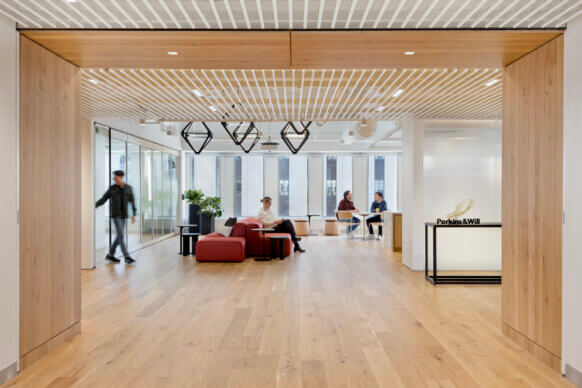
A Job Opportunity at 6 and a Half Months Pregnant
By Yanel de Angel
I was precisely six and a half months pregnant with my first child when a Perkins&Will principal invited me to interview at the firm. We had worked together before, and he knew my career goals were not supported where I currently was. Part of my unhappiness came after I told my direct boss that I was three and a half months pregnant. He decided to remove me from the projects I was working on and the ones in the pipeline. His reasoning was that clients needed continuity. From that point until maternity leave, I was asked to switch gears to administrative tasks, such as LEED administration.
For the first time in my life, I felt my career had collapsed. Up until then, I had given all my energy to architecture, was recognized with honors at the academic institutions I attended, and was a rising designer. I felt penalized for being pregnant. As a last resort, I went to the human resources office and they assured me they would look into it. However, human resources just went straight to my boss, who then stormed into the studio and said something along the lines of: “How dare you go to HR! What I told you is final. Our clients need continuity. I do not need to be scolded by HR. I can’t believe you went to them.” Feeling completely deflated by the exchange, which also played out in front of my colleagues, I shrugged and decided to just ride the wave until my maternity leave.
That evening, I went home and had a long discussion with my husband who suggested I take legal action or resign. After a few days of discussing it, I decided legal action would likely put a red flag on my name as the woman who stirred things up in the architectural community. I made myself believe that no one would have hired me had I taken legal action. I also talked myself into staying and going along with it because I was not financially prepared to be off a job. After all, who would hire me while I was pregnant?
Fast forward to my interview with Perkins&Will. To my surprise, they offered me a position and the opportunity to transition jobs at six and a half months pregnant with a three-month paid maternity leave. My reaction to the principal who made the offer was: “You guys must be crazy. I am too far along this pregnancy to start this job and I will feel terrible if I take advantage of a maternity leave I have not earned.” The principal replied that in the big scope of things, my pregnancy was a life experience that was going to evolve and that they were interested in my long-term contributions. I wished I had the clarity, wisdom, and courage to accept the offer right then. I was still struggling with defeat and even felt guilty of deserving better. Therefore, I declined the offer but asked the principal if we could stay in touch.
I rode the wave at this non-supportive firm and took nine months of unpaid maternity leave. I stayed in touch with the Perkins&Will principal. When my daughter was nine months old, I accepted Perkins&Will’s offer, and it has been the most supportive, open, and appreciative place I have ever worked at. When people ask me why I have been with the firm for 10+ years, I tell them it’s because they were the firm willing to hire me at six and a half months pregnant because they believed in my long-term contributions. And, people always reply, “Tell me more.”
For 11 years, I have kept this story secret and only shared it with few people, often in a whispering tone as if it needed to be hushed up. However, two events inspired me to share it. First, I joined the Women in Design (WiD) group at my local AIA chapter. I quickly became involved in committees and co-founded the Mid-Career Mentorship program. This story resonated with so many women who were in childbearing years. They felt inspired to advocate for a career where family life was integrated and supported. Second, Perkins&Will supported the #MeToo movement, and that day, I felt empowered to share my story.
We use cookies to enhance your browsing experience and analyze our traffic. By clicking "Accept All", you consent to cookies. For more information, view our privacy policy.
Cookie Preferences
Manage your cookie preferences below:
Essential cookies enable basic functions and are necessary for the proper function of the website.
Name
Description
Duration
pwCountryCode
-
Geolocation Config
This cookie is used to store the consent settings based on the visitor's location.
30 days
Cookie Preferences
This cookie is used to store the user's cookie consent preferences.
30 days
CloudFlare provides web performance and security solutions, enhancing site speed and protecting against threats.
The cf_ob_info cookie provides information on: The HTTP Status Code returned by the origin web server. The Ray ID of the original failed request. The data center serving the traffic
session
cf_chl_rc_i
These cookies are for internal use which allows Cloudflare to identify production issues on clients.
session
cf_chl_rc_ni
These cookies are for internal use which allows Cloudflare to identify production issues on clients.
session
cf_chl_rc_m
These cookies are for internal use which allows Cloudflare to identify production issues on clients.
session
__cfruid
Used by the content network, Cloudflare, to identify trusted web traffic.
session
__cf_bm
Cloudflare's bot products identify and mitigate automated traffic to protect your site from bad bots. Cloudflare places the __cf_bm cookie on End User devices that access Customer sites that are protected by Bot Management or Bot Fight Mode. The __cf_bm cookie is necessary for the proper functioning of these bot solutions.
session
__cflb
When enabling session affinity with Cloudflare Load Balancer, Cloudflare sets a __cflb cookie with a unique value on the first response to the requesting client. Cloudflare routes future requests to the same origin, optimizing network resource usage. In the event of a failover, Cloudflare sets a new __cflb cookie to direct future requests to the failover pool.
session
_cfuvid
The _cfuvid cookie is only set when a site uses this option in a Rate Limiting Rule, and is only used to allow the Cloudflare WAF to distinguish individual users who share the same IP address.
session
cf_clearance
Whether a CAPTCHA or Javascript challenge has been solved.
session
__cfseq
Sequence rules uses cookies to track the order of requests a user has made and the time between requests and makes them available via Cloudflare Rules. This allows you to write rules that match valid or invalid sequences. The specific cookies used to validate sequences are called sequence cookies.
session
cf_use_ob
The cf_use_ob cookie informs Cloudflare to fetch the requested resource from the Always Online cache on the designated port. Applicable values are: 0, 80, and 443. The cf_ob_info and cf_use_ob cookies are persistent cookies that expire after 30 seconds.
session
__cfwaitingroom
The __cfwaitingroom cookie is only used to track visitors that access a waiting room enabled host and path combination for a zone. Visitors using a browser that does not accept cookies cannot visit the host and path combination while the waiting room is active.
session
Google reCAPTCHA helps protect websites from spam and abuse by verifying user interactions through challenges.
Name
Description
Duration
_GRECAPTCHA
Google reCAPTCHA sets a necessary cookie (_GRECAPTCHA) when executed for the purpose of providing its risk analysis.
179 days
WPForms is a user-friendly WordPress plugin for creating custom forms with drag-and-drop functionality.
Name
Description
Duration
wpfuuid
Used to track user interactions with forms.
11 years
Statistics cookies collect information anonymously. This information helps us understand how visitors use our website.
Google Analytics is a powerful tool that tracks and analyzes website traffic for informed marketing decisions.
Used to determine whether a user is included in an A / B or Multivariate test.
18 months
_ga
ID used to identify users
2 years
_gali
Used by Google Analytics to determine which links on a page are being clicked
30 seconds
_ga_
ID used to identify users
2 years
_gid
ID used to identify users for 24 hours after last activity
24 hours
_gat
Used to monitor number of Google Analytics server requests when using Google Tag Manager
1 minute
_gac_
Contains information related to marketing campaigns of the user. These are shared with Google AdWords / Google Ads when the Google Ads and Google Analytics accounts are linked together.
90 days
__utma
ID used to identify users and sessions
2 years after last activity
__utmt
Used to monitor number of Google Analytics server requests
10 minutes
__utmb
Used to distinguish new sessions and visits. This cookie is set when the GA.js javascript library is loaded and there is no existing __utmb cookie. The cookie is updated every time data is sent to the Google Analytics server.
30 minutes after last activity
__utmc
Used only with old Urchin versions of Google Analytics and not with GA.js. Was used to distinguish between new sessions and visits at the end of a session.
End of session (browser)
__utmz
Contains information about the traffic source or campaign that directed user to the website. The cookie is set when the GA.js javascript is loaded and updated when data is sent to the Google Anaytics server
6 months after last activity
__utmv
Contains custom information set by the web developer via the _setCustomVar method in Google Analytics. This cookie is updated every time new data is sent to the Google Analytics server.