Perspectives December 3, 2025

The Onstage/Offstage Model in Pediatric Specialty Clinics: Limitations and Potential

By Sapna Bhat and Razan Alshadfan
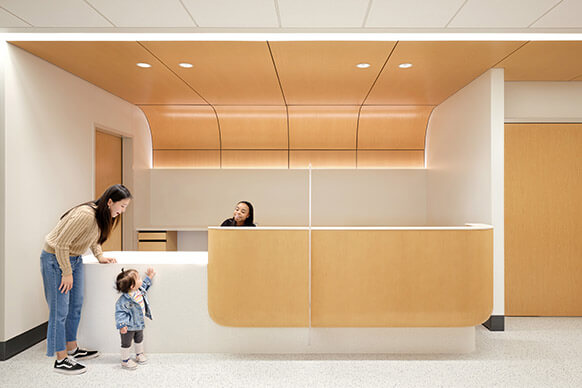
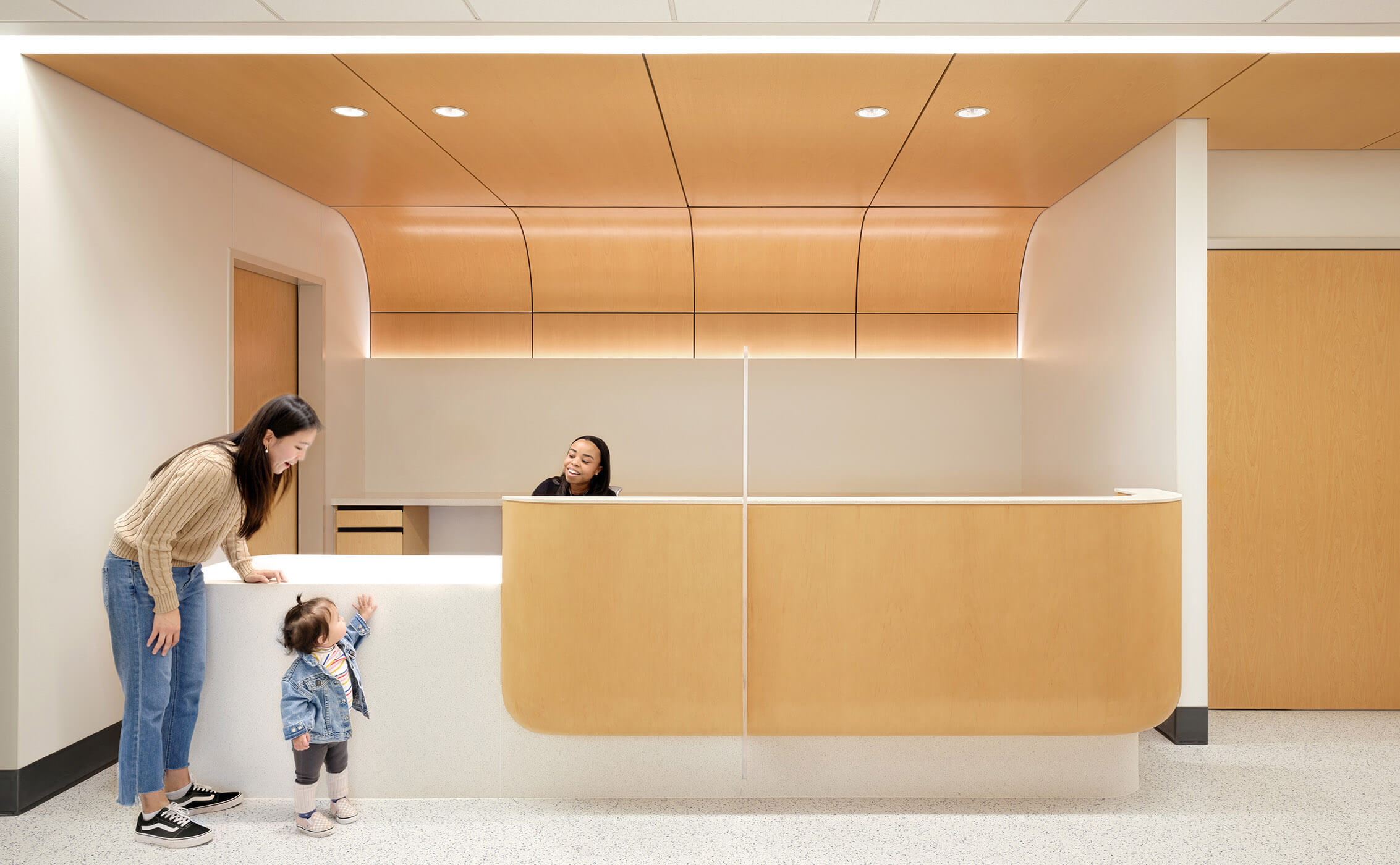
Modern reception area with a woman and child at a counter, sleek wood design.

When families walk into a pediatric specialty clinic, they bring more than an appointment time. They bring hopes, questions, stress, and the weight of caring for a child who needs expert attention.

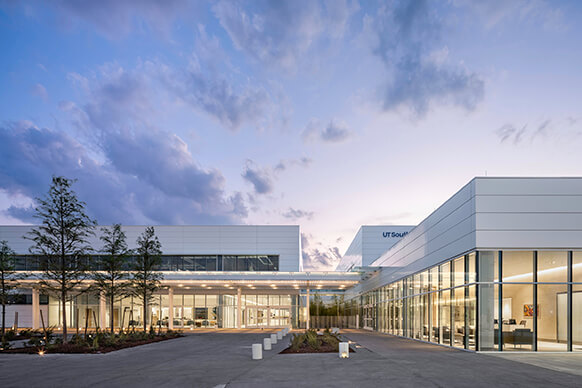
In these moments, architecture and interior design become part of the care team, either easing the patient journey and care delivery or adding friction. That belief guided our planning and design of the new Children’s Health Plano Heart Center Cardiology and Fetal Clinic, which recently received a national IIDA Healthcare Design Award for its approach to patient and provider experience.

One of the planning strategies explored in this project was the onstage/offstage model, a concept often discussed in modern outpatient design for its advantages. But while it supports a high-functioning operational rhythm and an intuitive patient experience, the model is not without limitations. The Children’s Plano clinic provides insight into the potential of onstage/offstage design and inspiration for interventions that respond to its challenges.
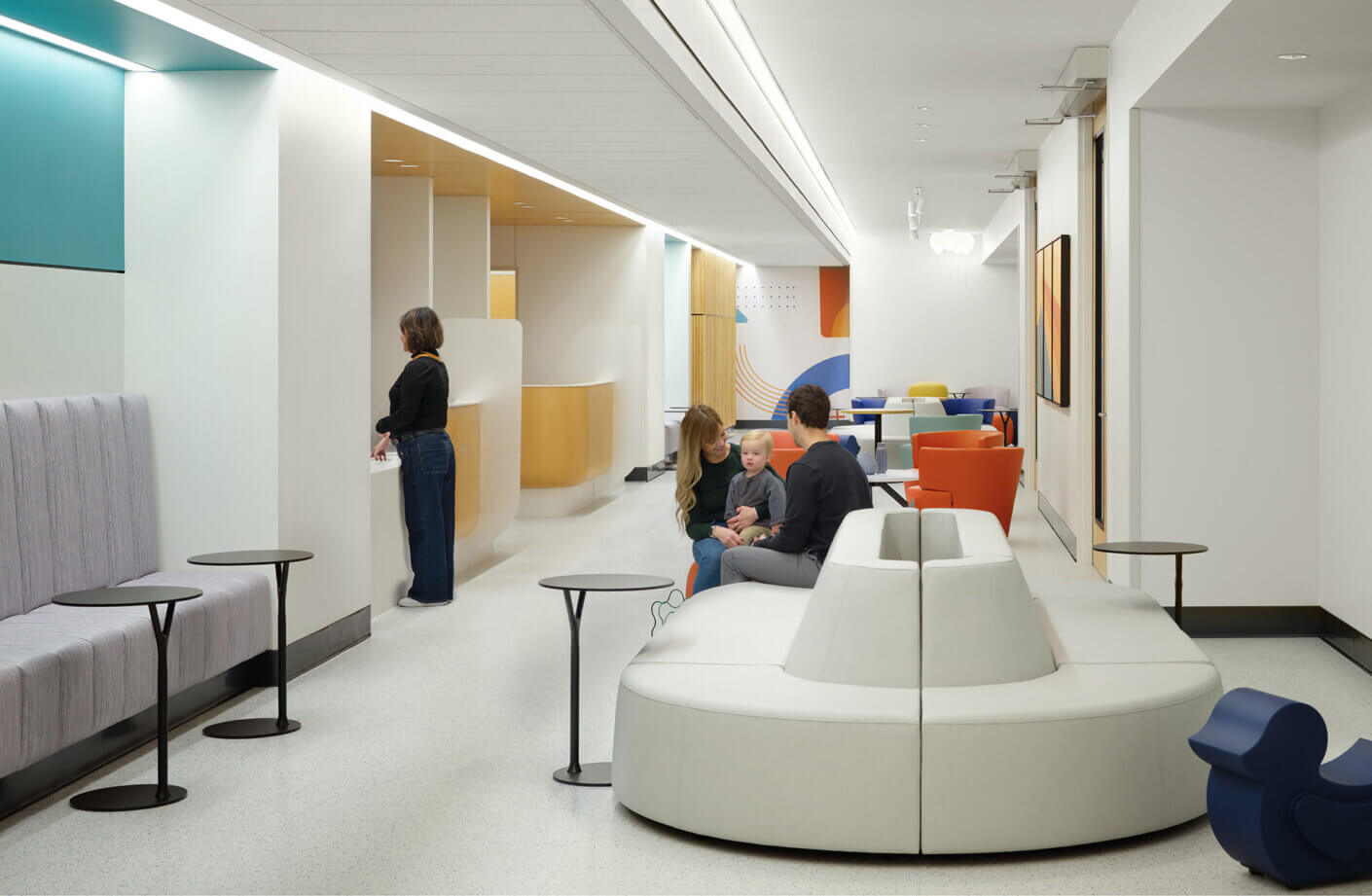
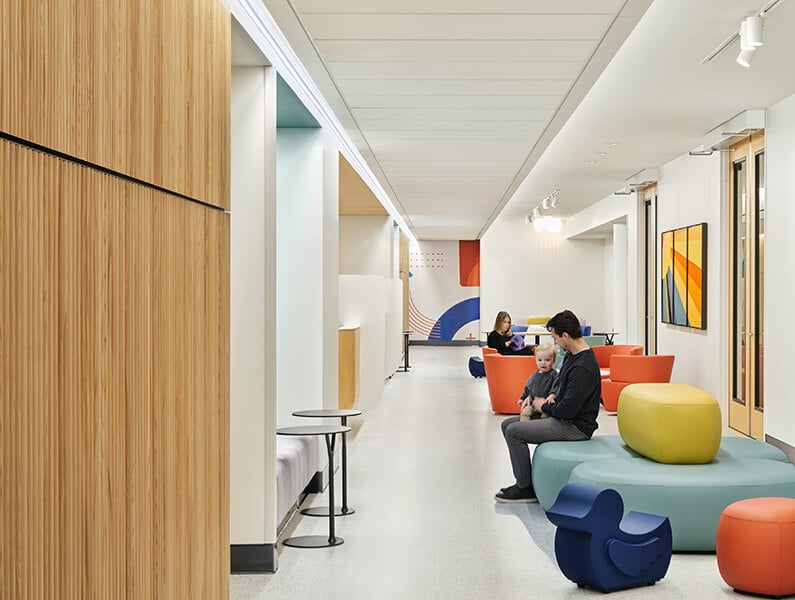
Modern waiting room with colorful seating and people interacting.
Pediatric patient reception at the clinic
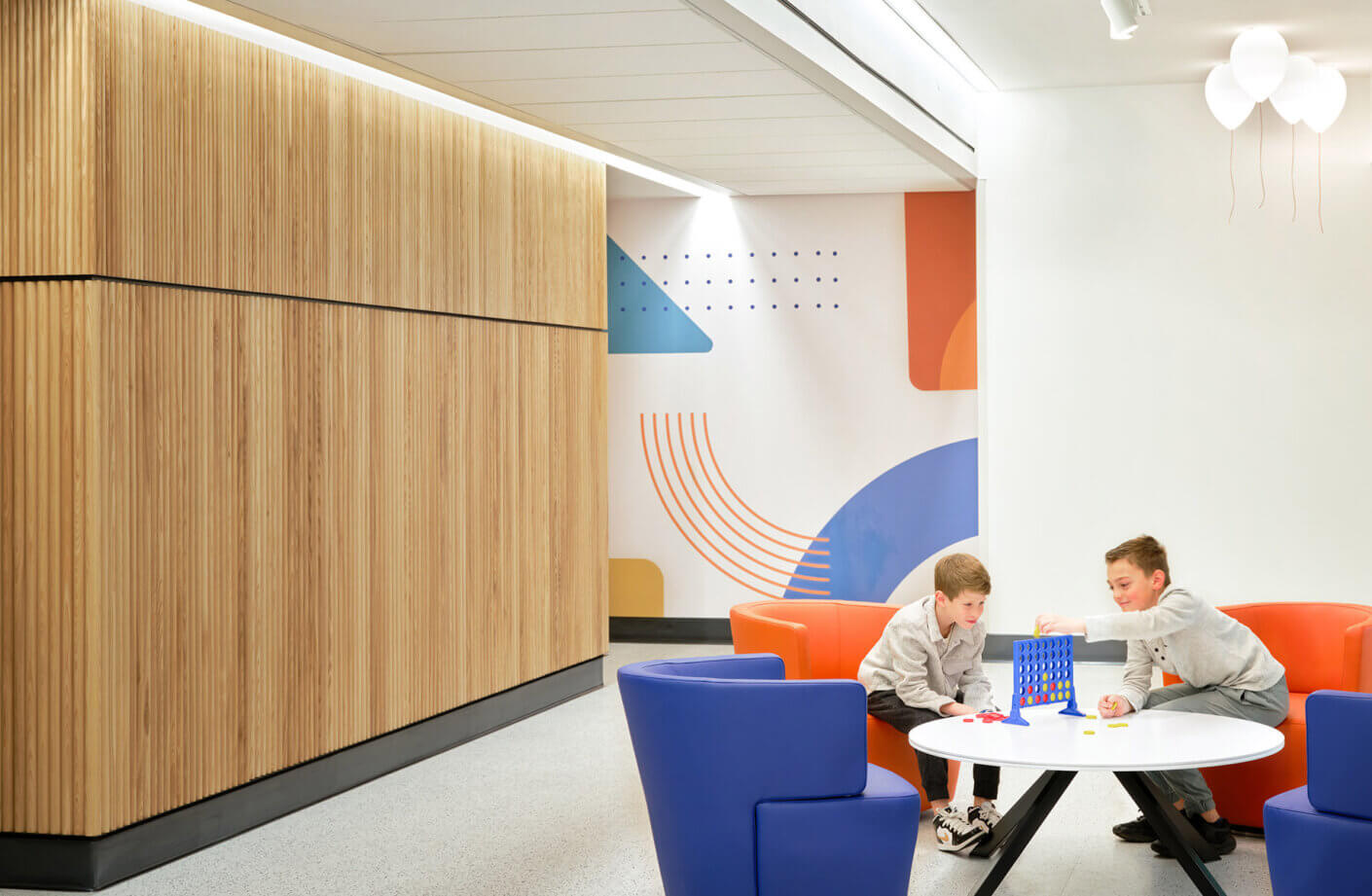
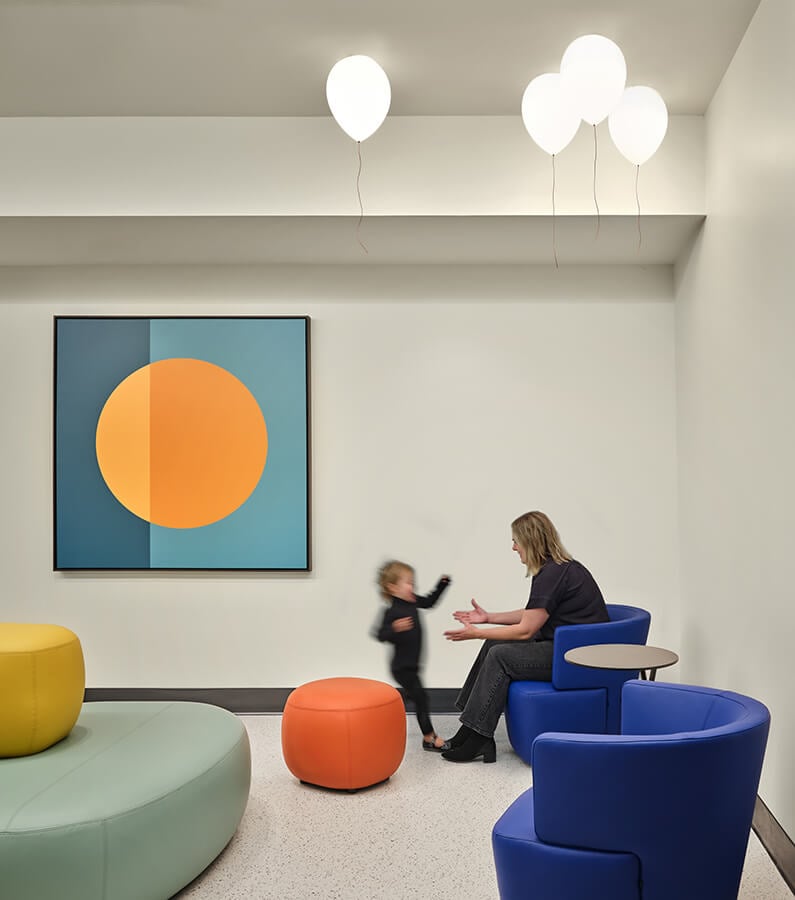
Modern room with colorful seating, abstract art, and balloon-shaped lights. Child and adult interacting.
How Onstage/Offstage Informs Experience

The onstage/offstage model separates public and staff circulation, giving patients and families a dedicated arrival and movement path, while staff navigate behind the scenes.

In theory, this clarity fosters a calmer, more predictable experience that is particularly relevant to specialty clinics where stress levels may be higher. The separation creates a streamlined, patient-forward environment that feels more like hospitality, with all back-of-house operations kept discreetly out of sight. Meanwhile, clinicians benefit from intuitive circulation that lets them collaborate efficiently and confidently, with HIPAA privacy built into the spatial organization.

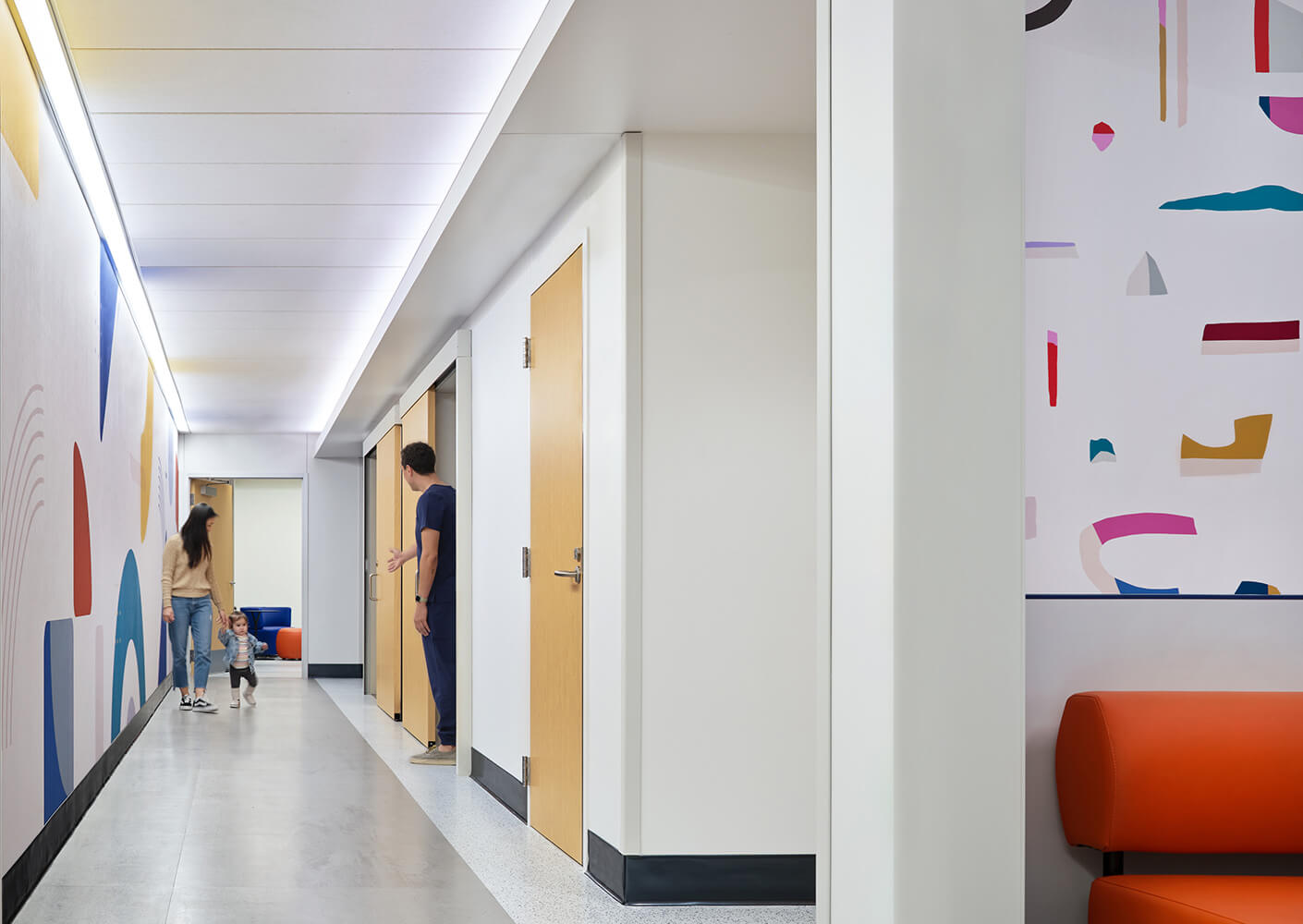
A dedicated patient circulation hallway

At Children’s Plano, the onstage/offstage model means families move seamlessly from reception to exam without exposing young patients to potential overstimulation from back-of-house activity. The separation also enhances operations and throughput, which supports overall provider functionality and has improved the experience for staff.

Throughout the clinic as a whole, material warmth and intuitive circulation cues layered onto this model turn functional efficiency into an emotionally supportive environment. Additionally, our lighting strategies around the clinic—a blend of integrated lighting and borrowed light through interior windows and glazed partitions—provide a soothing ambiance to enhance a sense of well-being. Child-friendly graphics and colors against a neutral backdrop, curated furniture and nooks, and playful touches like balloon-shaped lights create positive distraction and a holistically welcoming experience.

Where the Model Can Challenge Experience

No planning strategy, however, comes without trade-offs. In pediatric facilities, special considerations and design solutions can offset some of these common challenges.

Visibility

One of the most notable tensions in an onstage/offstage approach is visibility. While separation protects privacy and supports operational flow, families often want reassurance that help is nearby. The model can risk patients feeling alone or unseen.

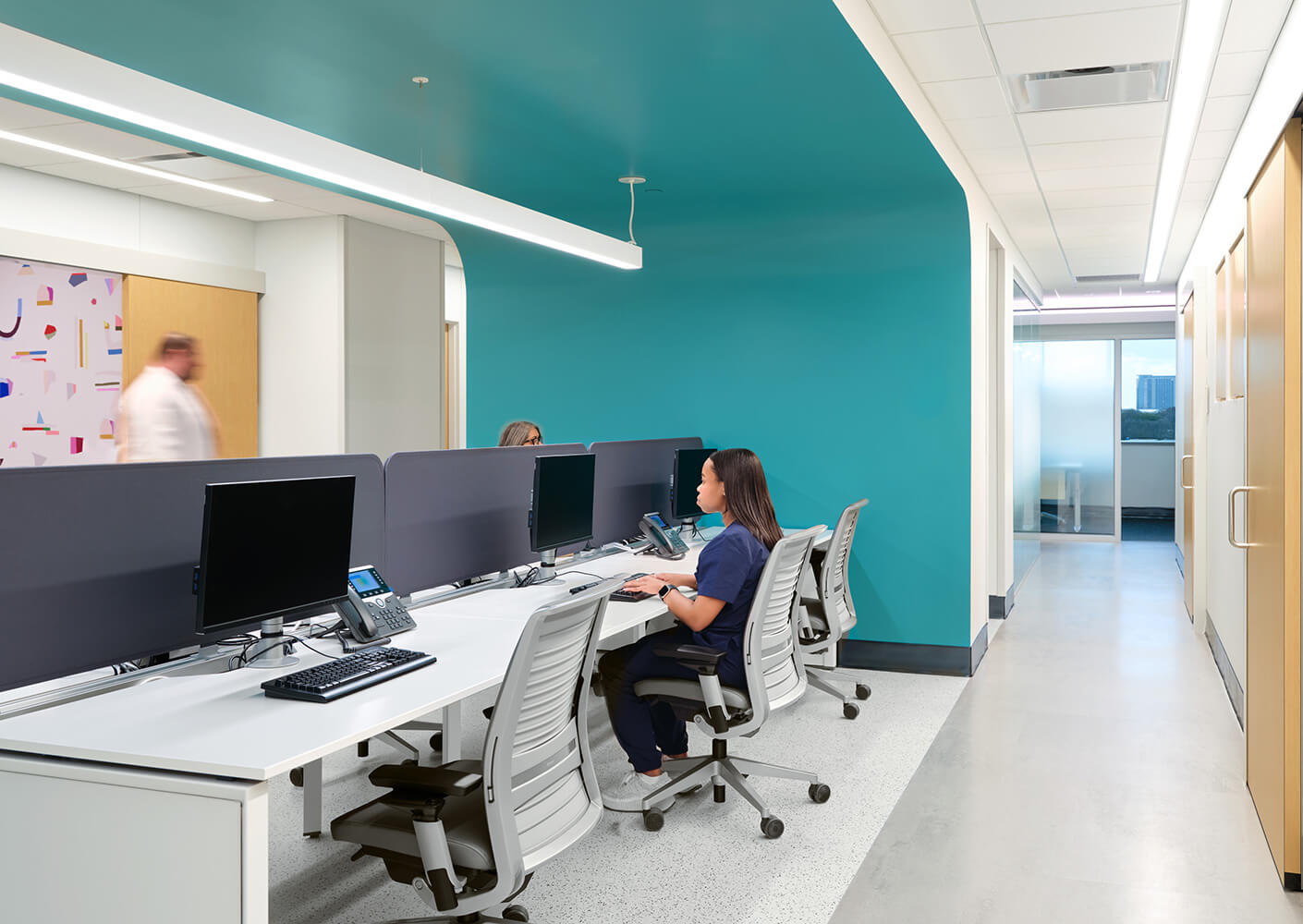
At Children’s Plano, this tension is alleviated with spatial adjacency between staff collaboration pods and exam rooms, and by operational workarounds like nurses accompanying patients to their rooms. Caregivers remain close even when not immediately visible. In this specific location, the building’s floor plate made it impractical to extend visual connections into patient corridors, but in other spaces, transparency—through glazed interior panels, for example—is another potential solution, providing subtle and reassuring cues of activity without constant exposure.

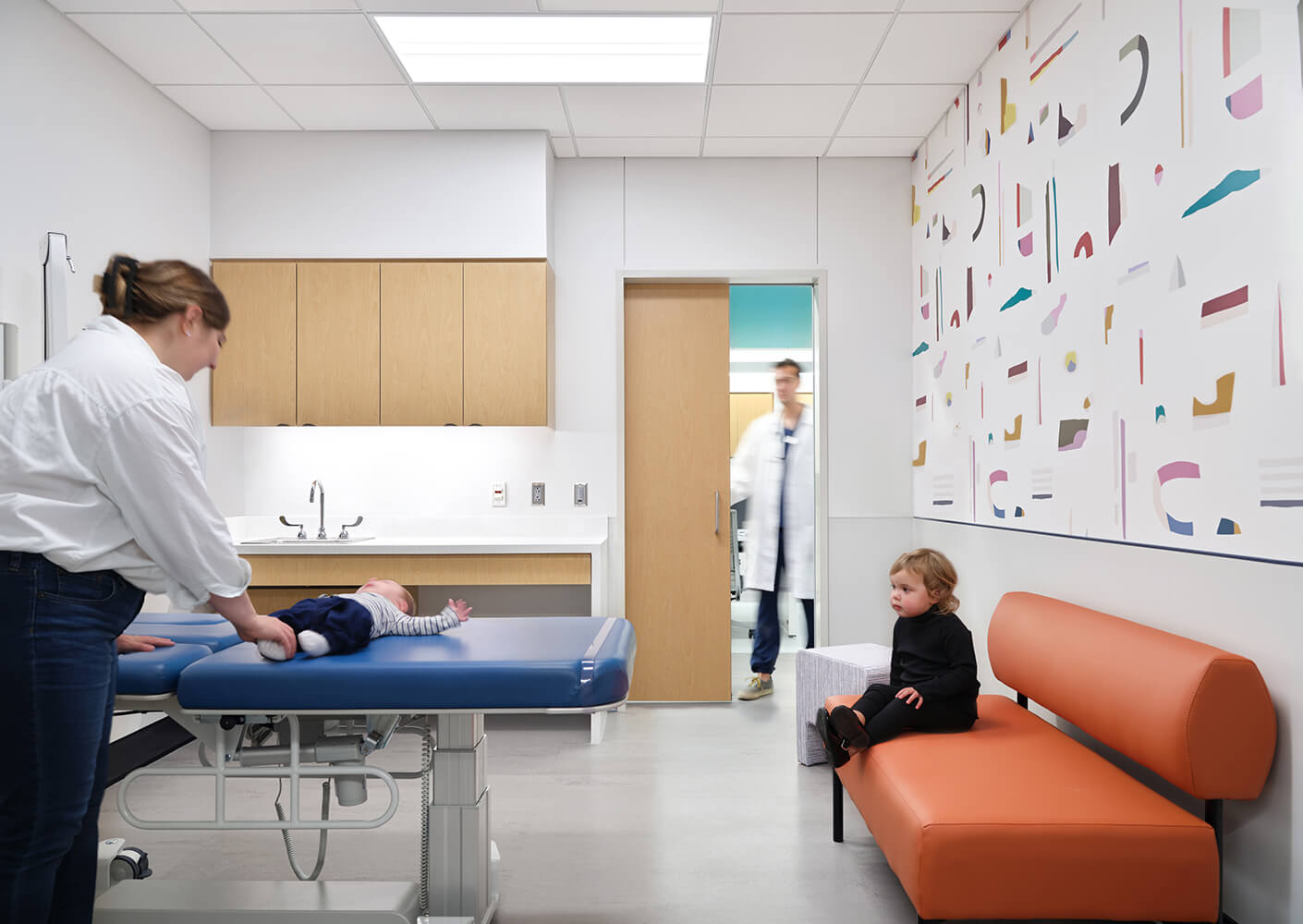
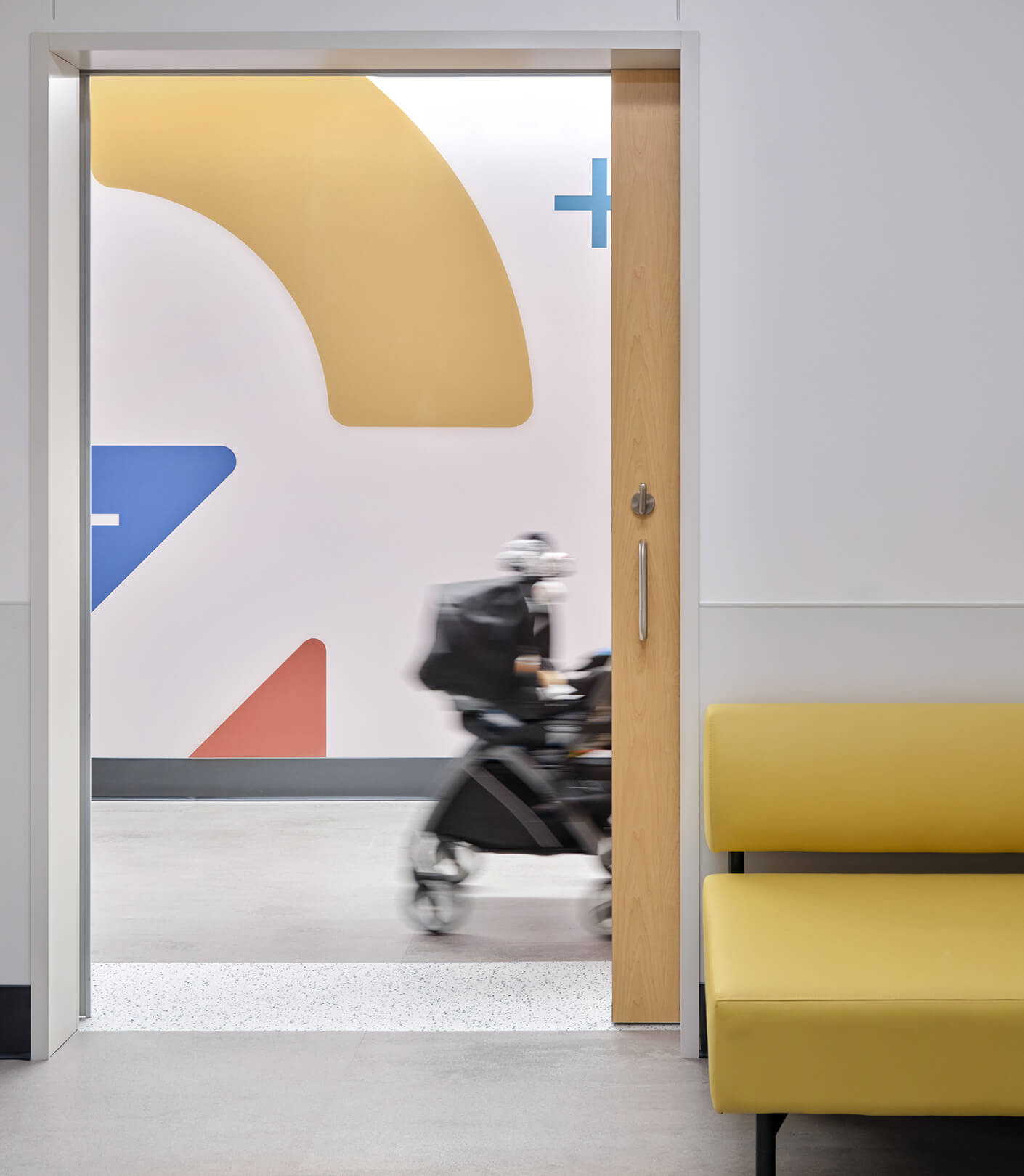
Exam rooms each have two doors: one to a patient hallway and one to physician workstations.
Acoustics

Onstage/offstage models may result in quiet clinical corridors. While noise often elevates stress, silence in a healthcare setting can also be worrisome. Children and caregivers can become uneasy about preserving confidentiality or feeling overly exposed in their conversations.

Materiality, lighting, and playful graphics, while not necessarily changing the acoustics of a space, add enrichment and energy along the patient journey. Instead of sterile quiet, these elements offer a sense of gentle warmth and an atmosphere where calm does not mean lifelessness. Beyond visual “noise,” acoustics can be tuned directly to address these issues. White noise is a calming strategy in use at Children’s Plano to mask conversation and buffer ambient sound, protecting privacy while avoiding the unease of total silence. For many young patients in an unfamiliar clinical environment, these experiential design nuances matter as much as the circulation diagram.

Spatial Inefficiency

A common assumption is that onstage/offstage planning means a sacrifice in operational square footage. While that can be true in some contexts, at Children’s Plano there was an insubstantial difference when comparing models during planning. Additionally, onstage/offstage in this context increased clinical efficiency.

Here, physician workstations flank identical exam and echo rooms, creating organized pods. By stitching together one pod per team, the pediatric clinic and a connected fetal clinic can share infrastructure, functioning like an accordion that flexes the allocation of standardized space to meet changing demand. Rather than reducing square footage at Children’s Plano, the onstage/offstage framework not only accommodates different provider groups and users but also helps support long-term adaptability.

With flexible planning strategies and operational alignment, the square footage at Children's Plano is allowed to work harder and smarter.
When On/Offstage Isn’t the Right Fit

Not every environment benefits equally from this model. Smaller clinics, programs that depend heavily on staff visibility, or facilities serving communities who gain comfort from face-to-face presence may be better served by different circulation strategies. In those cases, some of Children’s Plano’s design solutions can introduce clarity without full separation: scale shifts to mark transitions instead of doors, material and color cues to intuitively guide movement, and small touchdown zones with elements of privacy near patients to maintain proximity without blurring boundaries.

Brightly lit modern lounge area with colorful seating, parent relaxing with child in lap, and geometric wall art.
Children playing a board game in a modern, vibrant lounge area with three balloon-shaped lights overhead
Evolving the Approach

The onstage/offstage model is less a rigid, one-size-fits-all plan and more an adaptable approach to improve the efficiency and experience of care. The future will likely be hybrid, with strategic visibility where reassurance matters most, and thoughtful adjacencies to maintain proximity without compromising privacy. Technology will likely play a greater role, from digital check-in reassurance to predictive wayfinding and family-communication touchpoints.

Children’s Plano offers a view into where this model can be most effective: when it is shaped around empathy and built for operational flexibility. Our design solutions emerged from the client’s specific needs and are grounded in the lived experiences of young patients and their families, as well as how staff actually move through their day. The onstage/offstage framework is not a universal solution, but one tool in a broader planning toolkit, applied here with discipline and care for a highly specialized and sensitive pediatric setting.