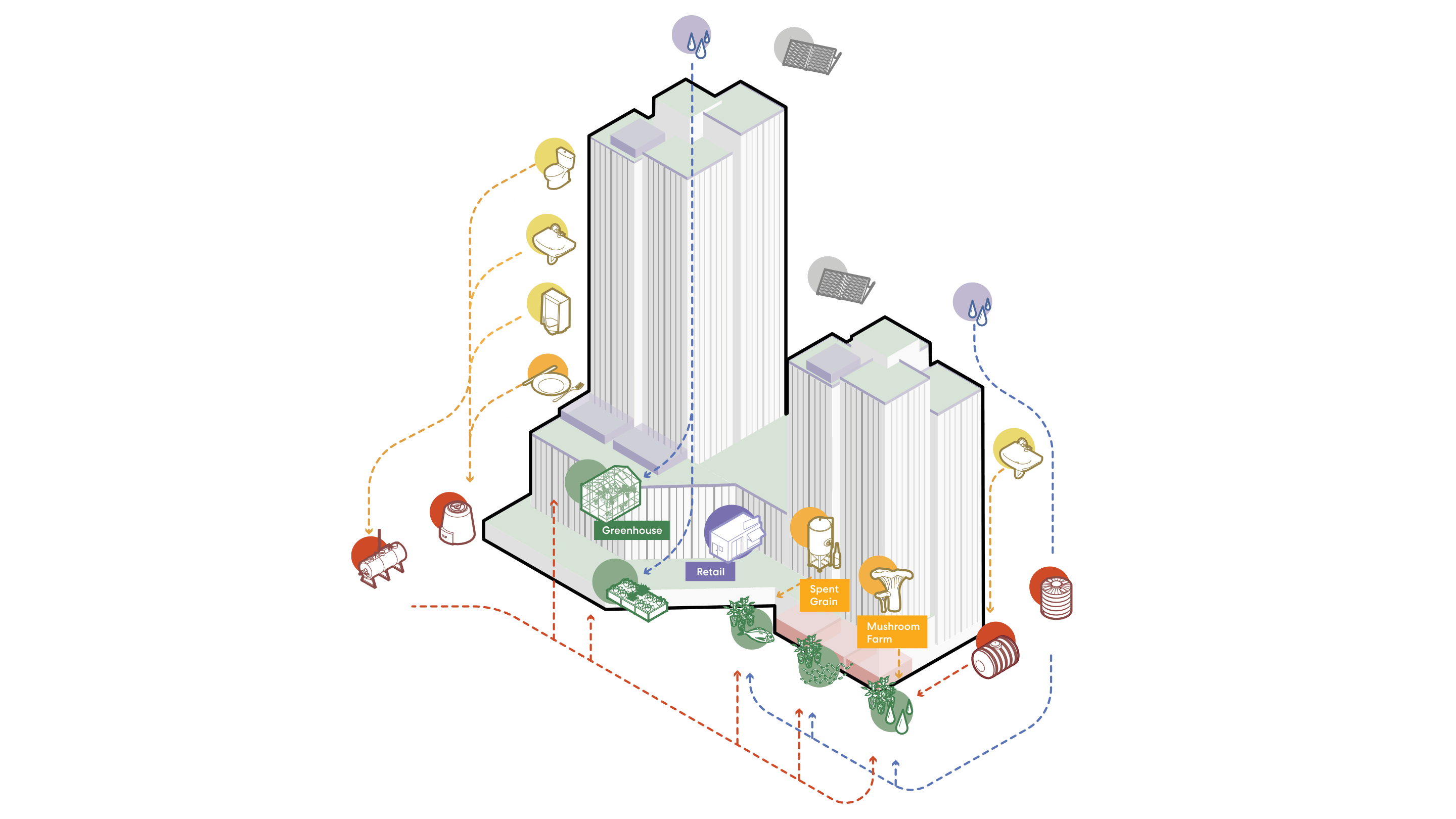

Since 2018, Vancouver has required developers to incorporate sustainable strategies like public transit, water management, and affordable housing into their rezoning applications for large development projects. The city also mandates expanded access to healthy, locally grown food by providing three diverse on-site “food assets,” such as rooftop gardens, edible landscaping, food processing facilities, and community markets.
“The city is responding to the fact that we’re extremely reliant on agricultural imports,” says Alycia van der Gracht, co-founder of QuantoTech Solutions, a company that designs, manufactures, and operates vertical farms around the metro area. “Our population is growing, and we have to get creative about how we produce food. A big part of that is integrating with buildings.”
Bosa Properties, one of Vancouver’s largest end-to-end real estate companies, embraced innovation as part of its rezoning application for a proposed high-rise residential tower, Barclay x Thurlow. To meet the city’s food sustainability requirements, the team dedicated space for a community garden and committed to supporting a local mobile food market. But fulfilling the city’s requirement for a third food asset proved challenging. “We just didn’t have the space,” says Bruce Currie, senior development manager at Bosa Properties. “After some collaboration with the city, they suggested we consider an indoor vertical farm in the parkade—an innovative concept—and introduced us to QuantoTech.”
The concept involved designing a special room in an unused corner of the underground parking structure and fitting it up with shelving and lights to grow lettuce and other greens indoors. Staffing and seedlings for the vertical farm would be supplied by QuantoTech. “We have a decentralized ‘hub and spoke’ farming model,” says van der Gracht, explaining that space- and labor-intensive seeding, propagation, and equipment cleaning operations occur at “hubs” on the city’s outskirts. “The final growing stage happens at the ‘spoke’ farms in the cities, when the plants are starting to take up a lot more space. Our teams tend them, harvest them, and stock them in self-serve kiosks at the site.”
In addition to working out the supply side details and fine-tuning further operational and legal details with the city, the team also wanted to consider potential demand. To gauge residents’ interest in purchasing hyper-local produce, Bosa Properties piloted a program in one of its existing rental buildings, stocking refrigerated vending machines in the building lobby with fresh greens from a nearby farm. The response was overwhelmingly positive. “We thought we had a week’s supply, but it sold out within two days,” says Ayden Kristmanson, former sustainability specialist at Bosa Properties. “It quickly proved to us that our tenants truly valued this. We actually had to regroup and figure out how to keep up.”
Barclay x Thurlow is currently in the design phase, with an estimated completion in 2030. In the meantime, Bosa is focused on understanding the evolving needs of residents. “Our world is changing quickly, and our amenity offerings need to evolve with it,” Kristmanson says. “We’re seeing a growing interest in food security and access to fresh, local produce, and we’re designing with that in mind.”
The experience has been eye-opening, says Currie. “In our day-to-day work as developers, food systems aren’t usually front and center. Vancouver is leading the way, and what began as a requirement became something more meaningful. Once we understood the value it could bring to the daily lives of residents, it’s something we’d consider continuing to do, even if it’s not a requirement.”