One major challenge is that these facilities were built at different times, sometimes by different agencies, and grew organically over decades, resulting in inconsistent design standards and varying degrees of functionality. And although one transportation mode might work well within its paradigm, integration across systems is often lacking. In addition, technological advancements are rapidly outpacing operators’ abilities to plan and build physical improvements, meaning that decisions made today may not address travelers’ future needs.
To help facility owners anticipate change and create more efficient and predictable experiences for travelers nationwide, the Transportation Research Board (TRB) of the National Academies of Sciences, Engineering, and Medicine recently commissioned a new report: Intermodal Passenger Facility Planning and Decision-Making for Seamless Travel.
The report provides detailed information about planning, designing, and operating intermodal passenger facilities, which it defines as “a transportation hub served by at least two modes of travel with at least one travel mode being air, rail, bus, or passenger vessel.” The report also summarizes emerging trends, highlights exceptional projects, and suggests strategies for funding and financing improvements.
“This research was needed because of inefficiencies and poor connectivity between different modes of transportation, especially at major hubs like airports,” says Abubaker Azam, director of operation services at SFO, who served on the TRB’s advisory panel. “We wanted to recommend standard features and best practices for intermodal hubs and transit centers.”
The report addresses basic amenities like benches, rain shelters, and curb cuts as the building blocks of the passenger experience. These features are often taken for granted by travelers, but if they’re broken or missing, or if they operate in unexpected ways, they can cause frustration, inconvenience, or delay. Standardizing their presence and function helps provide consistent and predictable conditions across different modes of travel.
Beyond physical features, information systems and operating policies also play a role in the passenger experience, and some facilities have implemented more effective strategies than others. “Certain modes are doing really innovative things, but they’re not necessarily sharing best practices with other modes,” says Adam Cohen, a researcher at the Transportation Sustainability Research Center at the University of California, Berkeley.
As one example, Cohen cites managing curbside congestion, or the snarl of traffic that results when passengers are being picked up or dropped off by private cars, ride-hailing vehicles, buses, and shuttles. In general, airports are at the forefront of curbside management, while train stations and other hubs have lagged behind. “We needed research that could look at best practices from these different types of facilities and assemble them into a resource that would be widely accessible and create a cross-pollination of ideas across modes,” he says.
The report recommends close coordination among passenger facility operators, transportation service providers, and local governments to implement tools that help travelers before they even leave home. “We wanted to emphasize what we call the ‘complete trip concept,’” Cohen says. “It’s the idea that a person’s journey actually starts when they first think about taking a trip, and it doesn’t end until they arrive at their final destination. Every link in that chain is really important: trip planning, booking, payment, the transfer points, all the connections.”
Far from a proscriptive mandate that demands uniformity, the report shares best practices that form a backdrop on which to design creative strategies. “There’s a big saying in our world: If you’ve seen one airport, you’ve seen one airport,” Azam says. “Every airport is different, and what you really need is flexible design and scalable infrastructure.”
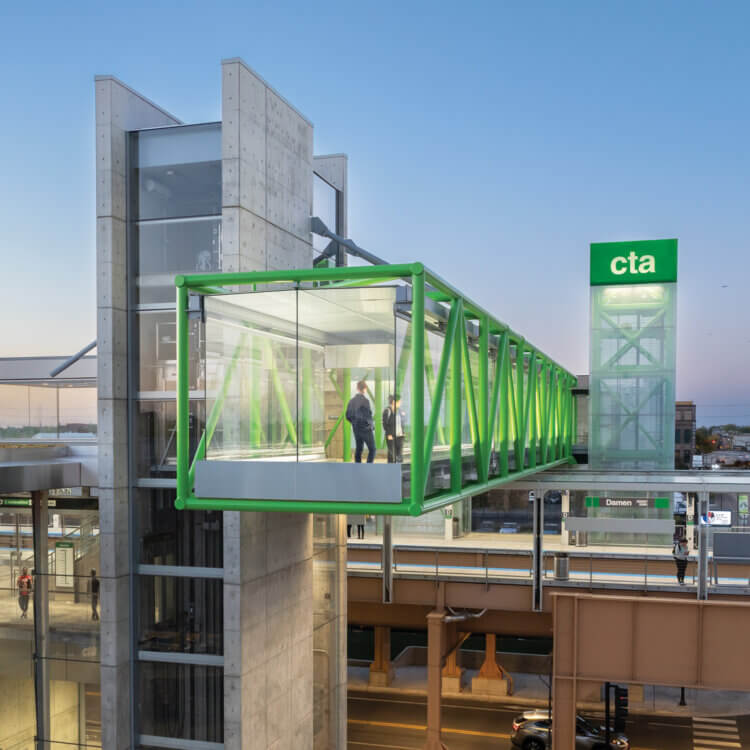
Although flexibility and scalability can be difficult to achieve in such complex facilities, decision-makers can accommodate new technology and major paradigm shifts by acknowledging that change is inevitable and thinking outside the box. For example, when ride-hailing services like Uber and Lyft became so popular that they were clogging SFO’s passenger pick-up areas, Azam and his team had to work within existing infrastructure to ease traffic congestion while still meeting passengers’ needs. They determined that the fifth level of the airport’s domestic parking garage, which had direct access to the road as well as pedestrian access via a sky bridge, could be converted to a pick-up area with clearly labeled zones to help drivers and riders connect safely and efficiently. “You have to be creative,” he says. “We were able to make it work.”
Creativity can extend to other aspects of a facility’s overall appearance and function, from retail and dining options, to artwork, to the ways branding and the broader community are reflected in signage and decor. Although the report stresses that an intermodal facility’s primary function is to serve travelers’ practical needs, it acknowledges that placemaking and economic elements also play a role in their journey.
“When you put all these different modes together, the sum is greater than the individual parts,” Cohen says. “We call it a ‘multimodal multiplier.’ People aren’t just making a transfer. They’re shopping. They’re experiencing art. They’re dining out. An intermodal hub can become a destination in itself.”