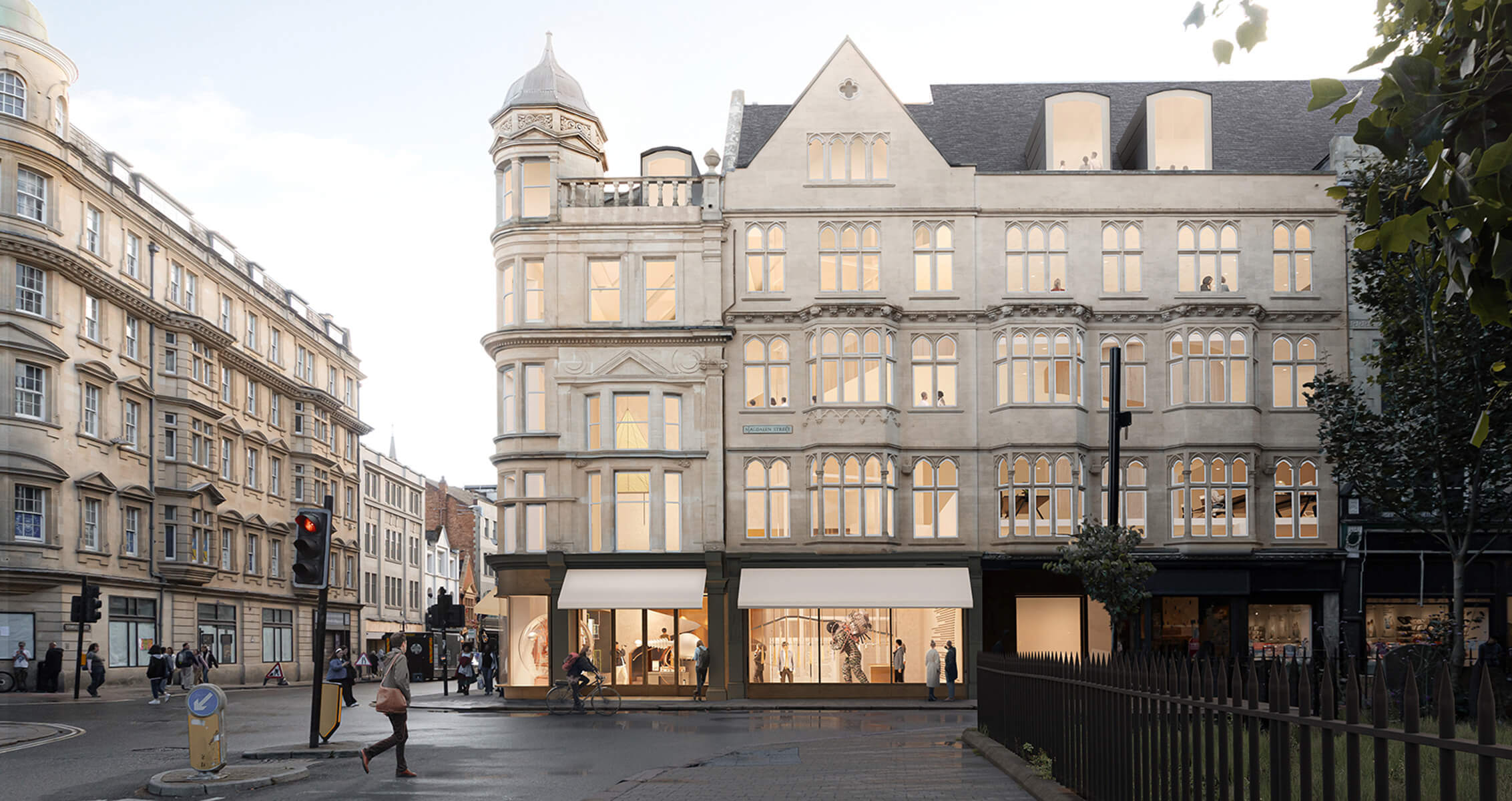
London—Perkins&Will has secured planning permission to transform a former Debenhams in the historic heart of Oxford into the UK’s first dedicated hub for innovative Human and Planetary Health enterprises.
Perkins&Will was appointed to lead the creative re-use of 1-12 Magdalen Street by a partnership between The Crown Estate, leading science and innovation developer Pioneer Group, and renowned venture builder Oxford Science Enterprises (OSE).
A truly pioneering project, 1-12 Magdalen Street will be the first commercial science facility in the heart of Oxford, located on the corner of George Street and Magdalen Street. This context supports a dynamic community of discovery, enabling established companies and organisations to meet knowledge intense SMEs, start-ups, and academic institutions, all within an eclectic mix of city centre offerings.
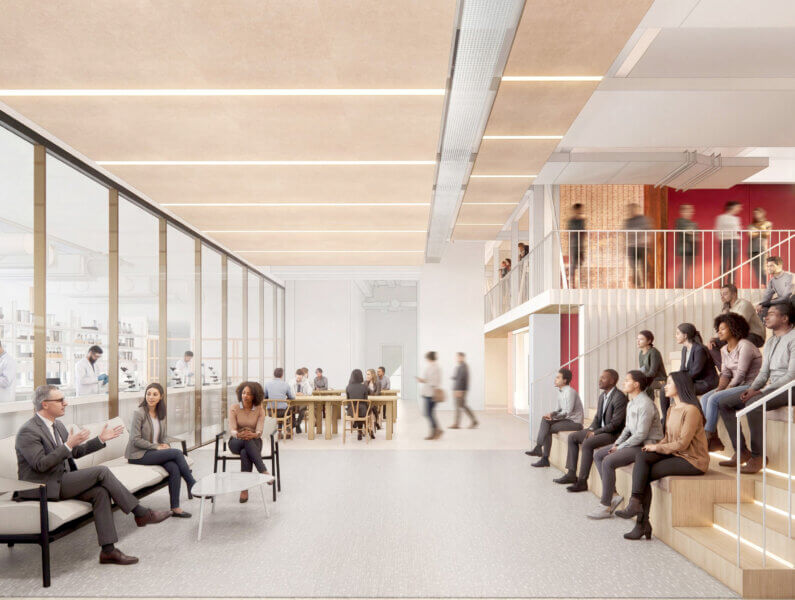
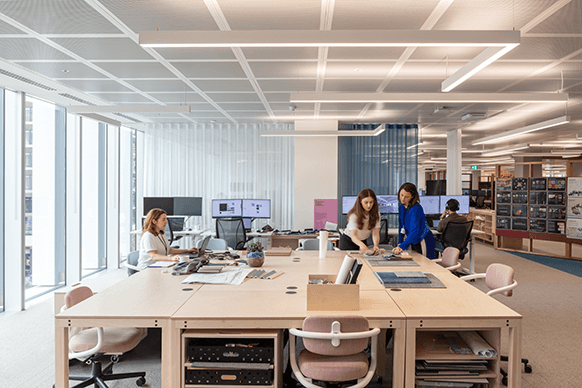
Perkins&Will’s design retains the existing late nineteenth-century structure and repurposes the upper floors into a purposefully designed 100,000-square-foot high performance incubator and accelerator spaces that will support the continual evolution of research. Alongside a range of labs, the building will also feature dedicated conference and events space, including a ‘Showcase Lab’ for OSE companies to make science and innovation more visible and accessible to younger audiences.
The project was given planning permission yesterday by Oxford City Council and work is now due to start on-site in the first half of 2027, with a targeted completion in 2029.
Daniel Parker, Principal, Practice Leader Science & Technology, says: “1–12 Magdalen Street is an important project for Oxford and the UK, as our transformation of this former Debenhams store will create the country’s first hub focused on Human and Planetary Health start-ups and scale-ups. Through careful refurbishment of the heritage facades and retention of the existing structure and fabric, we are giving the building a new lease of life and creating a home for pioneering research in the heart of the city. By reusing the existing building rather than replacing it, we are also significantly reducing the carbon footprint of the development and delivering a highly sustainable asset for the future.”
The deep refurbishment reuses the full envelope and structural fabric, extending the life of the building and generating significant carbon savings compared with a new development. Avoiding demolition of the steel frame and composite floor decks preserves the embodied carbon already in place and prevents the need for a new structure of similar carbon intensity.
Perkins&Will has calculated that the carbon saved through refurbishment, rather than demolition and new build, equates to 8,373 one-way flights from London to New York or 3,542 average family cars running for a year.
Located within the Oxford Central (City & University) Conservation Area, 1–12 Magdalen Street sits at the heart of Oxford University’s campus network, offering convenient walking and cycling connections for staff and students, as well as an exciting life sciences destination for the local community.
The development of 1-12 Magdalen Street represents an initial investment of c. £125 million from The Crown Estate and is part of the organisation’s commitment to invest £1.5 billion into the science, innovation and technology sectors over the next 15 years.
Oxford is the third most intensive science and innovation cluster in the world and ranks second globally for life sciences research. The university leads the world in university spinouts, with 210 created since 2011, contributing to a UK tech ecosystem that attracted more venture capital in 2023 than France and Germany combined.